![[IPWatchdog Logo]](https://ipwatchdog.com/wp-content/themes/IPWatchdog%20-%202023/assets/images/temp/logo-small@2x.png)
Other Barks & Bites for Friday, December 5: Tillis Blasts Lutnick Proposal on Government Share in Profits from Federally Funded Inventions; The Times Sues Perplexity AI; and USPTO Updates MPEP to Reflect Desjardins Decision
This week in Other Barks & Bites: The U.S. Patent and Trademark Office announced it has updated the Manual of Patent Examining Procedure to reflect recent eligibility guidance; The New York Times has sued Perplexity AI for copyright and trademark infringement; AGs from seven U.S. states sent a letter to the College Sports Commission calling out its “cartoonishly villainous” university participation agreement; and more.
Steve Brachmann
5 hours ago
 0
0
![[Advertisement]](https://ipwatchdog.com/wp-content/uploads/2025/12/Harfang-IP-Dec-11-2025-banner-1500x500-1.jpg)
USPTO Reminds Examiners, Applicants to Consider and Use Eligibility Declarations Wisely
The United States Patent and Trademark Office (USPTO) today released two memos meant to provide additional guidance around the use of patent subject matter eligibility declarations (SMEDs) for examiners, applicants and practitioners, particularly with respect to “applied technologies” in areas like artificial intelligence and medical diagnostics. The memos do not alter existing procedures and are effective immediately.
Eileen McDermott
December 4, 2025, 05:05 PM
0
Ninth Circuit Affirms Trademark Injunction Against OpenAI Company in Dispute Over Similar Marks
The U.S. Court of Appeals for the Ninth Circuit on Wednesday affirmed a district court’s decision to grant a temporary restraining order (TRO) in a trademark dispute between two tech companies, IYO, Inc., and IO Products, Inc, which merged with OpenAI in May 2025. The order prevents IO, a company co-founded by Sam Altman and Jonathan Paul Ive, from using the IO mark in connection with products that are related to IYO’s AI-based “audio computer.”
Rose Esfandiari
December 4, 2025, 01:15 PM
0
SCOTUS Delays Trump Bid to Oust Perlmutter Pending Arguments in Similar Cases
Last week, the U.S. Supreme Court issued an order deferring a decision in Trump v. Perlmutter, a case in which President Donald Trump is asking the Court to stay an interlocutory injunction issued by the U.S. Court of Appeals for the D.C. Circuit in September that allowed Register of Copyrights Shira Perlmutter to return to her post pending her lawsuit against Trump for removing her from office.
Eileen McDermott
December 4, 2025, 08:15 AM
1
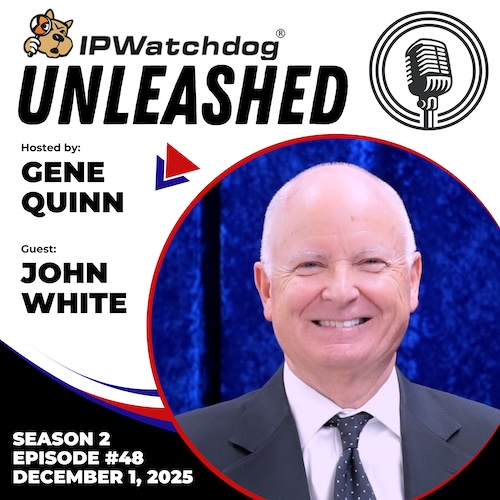
Navigating the Changing Patent Landscape with Gene Quinn and John White | IPWatchdog Unleashed
This week on IPWatchdog Unleashed, I was joined by my longtime friend John White, who is the the creator of the patent bar review course I’ve taught for almost 27 years. Together we explore the intricate and ever changing patent landscape. First, we begin by discussing the bar exam and how it is changing, then we pivot to the evolving role of AI in patent law more generally. Our conversation traversed decades of personal history, friendship and professional insights, revealing how the industry has transformed over the years and what it means for the current and future generation of patent practitioners.
Gene Quinn
December 2, 2025, 12:15 PM
0
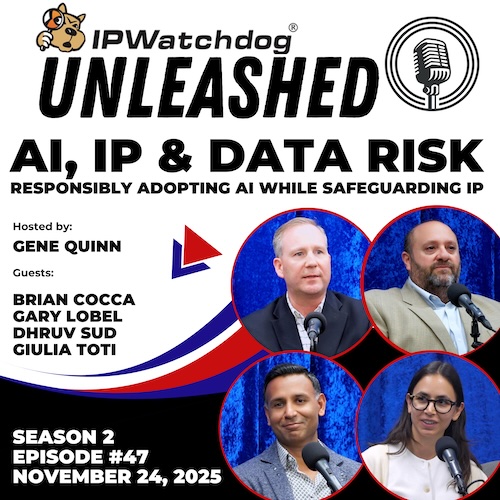
AI, IP and Data Risk: Responsibly Adopting AI While Safeguarding IP | IPWatchdog Unleashed
This week on IPWatchdog Unleashed, we feature a panel discussion that took place on October 27 as a part of our annual life sciences program. Initially styled as a conversation about how artificial intelligence is transforming life sciences, it became quickly apparent that the conversation was not going to be limited to the life sciences sector. Instead the discussion evolved into a robust discussion about data risk and intellectual property, focusing on what every innovative company should have front of mind when considering the adoption of AI tools.
Gene Quinn
November 25, 2025, 12:15 PM
0
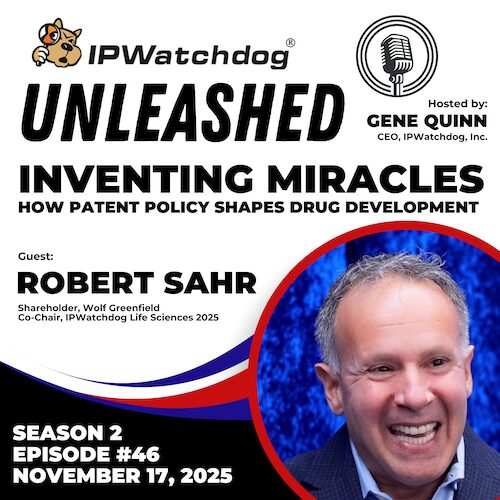
Inventing Miracles: How Patent Policy Shapes Drug Development | IPWatchdog Unleashed
In our latest IPWatchdog Unleashed podcast, I spoke with Rob Sahr, shareholder at Wolf Greenfield and co-chair of our 2025 Life Sciences Masters™ program. Our conversation zeroed in on a hard truth the public rarely sees: moving a molecule from early discovery to an FDA-approved therapy requires a chain of scientific and economic miracles—and every one of them leans on a reliable patent system. In this conversation we discuss the extraordinary journey from molecule to medicine. Together, we explore how scientific breakthroughs depend not only on research and capital, but also on a stable and predictable patent system. From double patenting and government funding to judicial uncertainty and policy headwinds, our conversation dives into the fragile balance between innovation and patent policy—and the many scientific miracles required to bring new drugs to life.
Gene Quinn
November 19, 2025, 04:15 PM
0
![[Advertisement]](https://ipwatchdog.com/wp-content/uploads/2025/11/PTAB-Masters-2026-banner-early-bird-1500x500-1.jpg)
Arnold & Porter is Seeking a Senior Manager of IP Administration
Arnold & Porter is an international law firm with 16 offices in the United States, Europe, and Asia that provides sophisticated regulatory, litigation, and transactional services across multiple industries. Arnold & Porter has an opening for a Senior Manager of IP Administration in the Washington, DC office. The Senior Manager of IP Administration oversees the firmwide IP Prosecution (Patent and Trademark) practice.
JobOrtunities Help Wanted
December 4, 2025, 05:15 AM
0
Current and Former Lawmakers Lock Horns in Comments on USPTO’s Proposed PTAB Changes
The deadline for comments on the U.S. Patent and Trademark Office’s (USPTO’s) Notice of Proposed Rulemaking (NPRM) issued in October, titled “Revision to Rules of Practice before the Patent Trial and Appeal Board,” was yesterday, December 2. As of today, the Office has received 10,783 comments and has published just over 1,000 of them. The rules have been broadly welcomed by IP holders and practitioners, and broadly opposed by those who want to preserve the option to easily challenge patents. Below, we summarize several submissions from individuals and organizations on both sides.
Eileen McDermott
December 3, 2025, 12:41 PM
5
SPONSORED
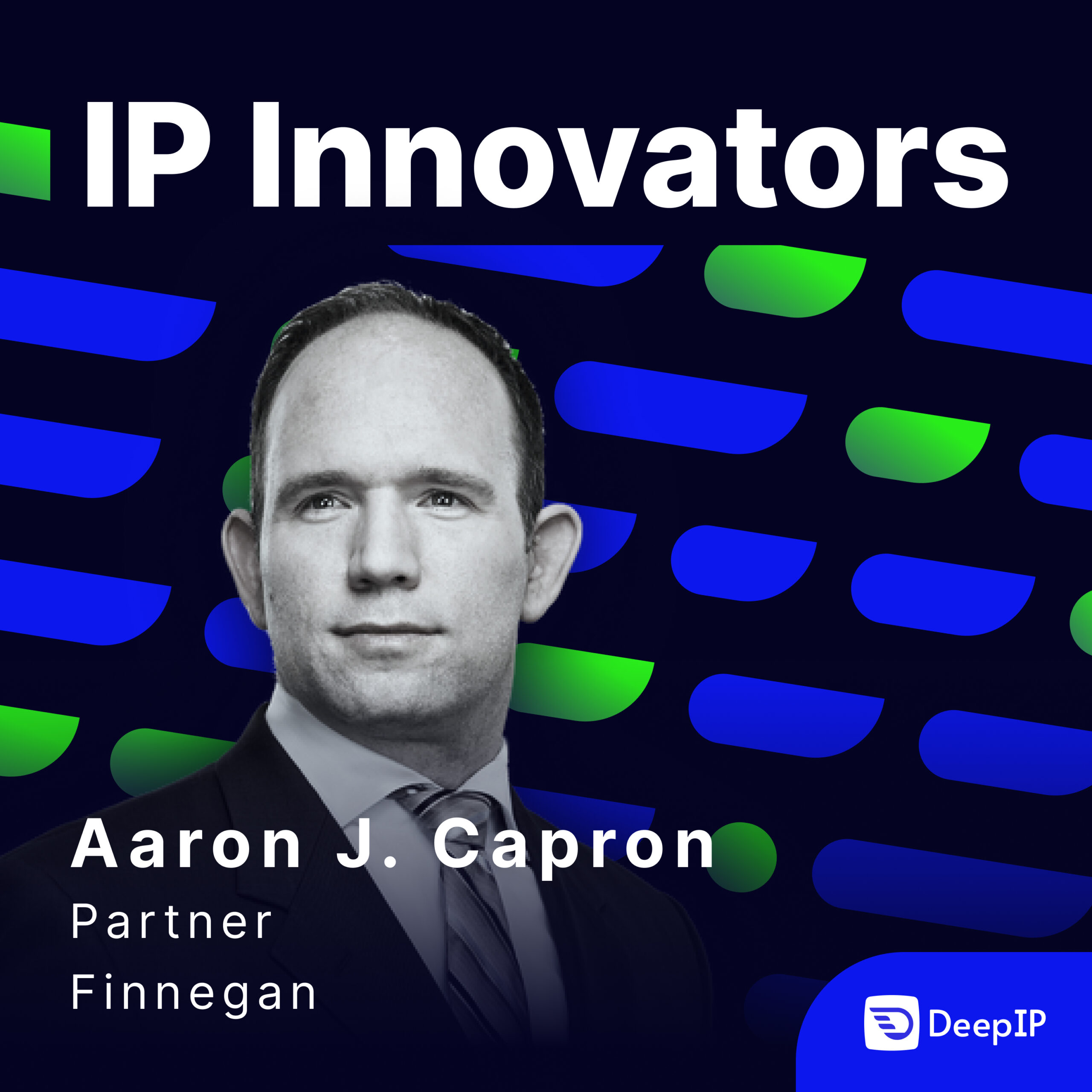
IP Innovators: When Engineering Meets Law: Aaron Capron’s IP Odyssey
In the latest episode of IP Innovators, host Steve Brachmann speaks with Aaron Capron, partner and head of the Patent Office Practice at Finnegan, about how patent prosecution is evolving across AI, quantum computing, semiconductors, and other rapidly developing fields. Throughout the discussion, Capron consistently returns to themes that resonate deeply with experienced patent practitioners: the importance of thinking like an examiner, the need for robust infrastructure to manage complex portfolios, and the reality that legal technology—especially AI—requires thoughtful integration, not simple adoption.
Francois-Xavier Leduc
December 3, 2025, 07:15 AM
0
The Personal Side of Patents: The Battle for Life-Saving Drugs | IPWatchdog Unleashed
In our latest IPWatchdog Unleashed podcast, we had a riveting and sometimes emotional conversation that unfolded around one of the most pressing issues in life sciences today: the journey of life-saving drugs from laboratory to patient. We discuss the pivotal role a strong patent system plays in this important journey with guest Sherry Knowles. Sherry is the founder of Knowles Intellectual Property Strategies and former Senior Vice President and Chief Patent Counsel for GlaxoSmithKline. In addition to being one of the leading voices in the life sciences and patent industries, Sherry is also a cancer survivor. Among other things we discuss numerous patent system challenges facing innovator drug companies, the downward pressure generic drugs place on the industry and leading to important drugs becoming unavailable, the role of Pharmacy Benefit Managers (PBMs) with respect to significantly raising the cost of drugs for Americans, and policy influences and legislation on Capitol Hill. Sherry also shares her personal story and insights into why patents are more than just legal constructs—they are deeply personal lifelines.
Gene Quinn
November 11, 2025, 03:15 PM
0
Patents, Patients & Progress: A Conversation with Henry Hadad | IPWatchdog Unleashed
This week on IPWatchdog Unleashed we tackle the impact of tariffs and geopolitical uncertainty on intellectual property (IP) strategy, budgets and patent portfolios. In today’s fast-paced global economy, intellectual property (IP) teams face unprecedented challenges and opportunities. The world is witnessing a flux of geopolitical tensions, economic uncertainties, and rapid technological advancements, all of which demand agility and strategic foresight from IP professionals. Meanwhile, to complicate matters the United States is attempting to rearrange international business norms by diversifying supply chains for particularly important goods and components, while simultaneously aggressively using tariffs to change global economic behavior and settle international conflicts and wars. There is no doubt that this is a tumultuous time for all businesses, which demands attention, forethought and deliberate strategic action.
Gene Quinn
November 4, 2025, 08:15 AM
0
Tariffs, Tech Wars, and Patent Turmoil: Navigating IP Strategy in a Rapidly Changing World | IPWatchdog Unleashed
This week on IPWatchdog Unleashed we tackle the impact of tariffs and geopolitical uncertainty on intellectual property (IP) strategy, budgets and patent portfolios. In today’s fast-paced global economy, intellectual property (IP) teams face unprecedented challenges and opportunities. The world is witnessing a flux of geopolitical tensions, economic uncertainties, and rapid technological advancements, all of which demand agility and strategic foresight from IP professionals. Meanwhile, to complicate matters the United States is attempting to rearrange international business norms by diversifying supply chains for particularly important goods and components, while simultaneously aggressively using tariffs to change global economic behavior and settle international conflicts and wars. There is no doubt that this is a tumultuous time for all businesses, which demands attention, forethought and deliberate strategic action.
Gene Quinn
October 28, 2025, 04:15 PM
1
Varsity Sponsors
![[Advertisement]](https://ipwatchdog.com/wp-content/uploads/2025/11/Juristat-Ad-Firm-Cost-Management-Nov-18-Dec-31-2025-Animated-Varsity-Ad-final.gif)
![[Advertisement]](https://ipwatchdog.com/wp-content/uploads/2025/11/PTAB-Masters-2026-sidebar-early-bird-700x500-1.jpg)

Latest Podcasts



IPWatchdog Events
Webinar: Remedies for Standards Essential Patent Disputes in the US
December 11 @ 12:00 pm - 1:00 pm ESTIPWatchdog LIVE 2026 at the Renaissance Arlington Capital View
March 22, 2026 @ 1:00 pm - March 24, 2026 @ 7:00 pm EDT
Industry Events
Stop Infringement in Its Tracks: An Expert Guide to Trademark Enforcement in China, Mexico, and Turkey
December 9 @ 8:00 am - 9:45 am EST
Subscribe to IPWatchdog
This is the best way to stay informed. We send a daily roundup of our latest news, press releases, and events.
Get Email Updates
Sponsored Content

Recent Podcasts
![[Advertisement]](https://ipwatchdog.com/wp-content/uploads/2021/12/WEBINAR-336-x-280-px.png)